Es dauert doch immer alles länger als geplant, aber es geht voran und gut Ding will ja bekanntlich Weile haben.
Die Bodenplatte trocknet jetzt ausgiebig, um die Kellerwände dann auch tragen zu können. Wir freuen uns schon auf den nächsten Schritt!
Es dauert doch immer alles länger als geplant, aber es geht voran und gut Ding will ja bekanntlich Weile haben.
Die Bodenplatte trocknet jetzt ausgiebig, um die Kellerwände dann auch tragen zu können. Wir freuen uns schon auf den nächsten Schritt!
Passend zum zeitweise doch etwas heißen Sommerwetter bewegt sich unsere Baustelle aktuell unter Tage. Die Erdarbeiten sind abgeschlossen und wir sind ziemlich überrascht welche Mengen an Sand da bewegt und aufgeschichtet wurden.

Aktuell befindet sich die Bodenplatte im Bau. Nachdem wir zwischenzeitlich sogar schon etwas vor dem Zeitplan waren, hat diese jetzt doch etwas länger gedauert, aber solange alles am Ende passt ist das vollkommen in Ordnung. Immerhin – es geht voran!

Die Zeit seit unserem letzten Blogeintrag ist unglaublich schnell vergangen. Wir sind froh, dem nassen und kalten Paris schon seit mittlerweile zwei Tagen entflohen zu sein.
Der Service bei Air Caraibes war erfreulich gut, auch wenn das für uns beide mit Abstand der Turbulenzreichste Flug war. Zum Glück haben wir keine Flugangst…
Direkt am Flughafen in St. Martin (SXM) haben wir uns mit Malte, unserem Skipper ab Samstag, getroffen. Wir sind dann zusammen per Taxi nach Marigot gefahren, waren noch in einer Bar und haben uns ein bisschen kennen gelernt.
Gegen 18:00 Uhr sind wir dann mit Sack und Pack und trotz erheblicher Bedenken von Malte losgezogen, um einen Zeltplatz zu suchen. Wir hatten schon vorher den Pic Paradies, den höchsten Berg auf der Insel, angepeilt. Als wir am Eingang der Straße zum Pic waren, wurde es leider schon dunkel und wir waren auch aufgrund des Jet Lags und der Anstrengung der vergangenen Tage etwas fertig.
Zum Glück war ein geeigneter Zeltplatz abseits der Straße, aber mit ebeneme Untergrund sehr schnell gefunden. Erst bei Helligkeit am nächsten Tag wurde uns allerdings bewusst, wie gut der Zeltplatz wirklich war, da er von der Straße komplett uneinsehbar war. Wir hätten wohl doch etwas erholsamer geschlafen, wenn uns dies schon vorher klar gewesen wäre. Die Aussicht am morgen war aber auch wirklich schön.
Es ging dann für uns weiter auf den Gipfel (450 Meter hoch) und auch obwohl wir den Geocache dort leider nicht finden konnten, war die Aussicht auf beide Seiten der Insel den rucksackbedingt anstrengenden Aufstieg mehr als wert.
Unser nächster Programmpunkt war die Abholung unseres Mietwagens direkt an der Marina in Anse Marcel um 17:00 Uhr. Bis dahin mussten wir noch fast 10 km zurücklegen, zum Glück war aber genug Zeit in der Baie de Grand Case einmal kurz ins Meer zu gehen und einen kühlen Cocktail am Strand zu genießen.
Der Weg zur Marina in Anse Marcel war dann in der glühenden Hitze und mit schwerem Gepäck etwas beschwerlich. Google Maps hat uns auch einen zwar sehr kurzen, aber steilen Fußgängerweg empfohlen, der sich dann relativ unvermittelt als Pfad durch eine Kuhwiese entpuppte und Julia etwas verunsichert hat.
Etwas verwundert waren wir aber dann, als wir zwar die Vermietstation gefunden hatten, dort aber niemanden antreffen konnten (20 Minuten vor Ende der angegebenen Öffnungszeit). Zum Glück war der Hertz-Desk in einem Hotel und die dortigen Rezeptionsmitarbeiter so nett, dass sie ca. 15 Minuten für uns herumtelefoniert haben. Letzlich hat uns dann ein Hertz-Mitarbeiter zurück zum Flughafen Grand Case gefahren (und uns nicht geglaubt, dass wir zu Fuß dahin gekommen waren), sodass unsere Kuhwiesenwanderung etwas umsonst war. Dafür haben dort aber tatsächlich ein ordentliches Auto bekommen.
Unser Versuch einen anderen Campingplatz zu finden scheiterte dann vor allem an der Dunkelheit, sodass wir wieder wie gewohnt am Pic Paradies übernachtet haben.


Heute morgen haben wir dann zwei andere Mitsegler in ihrer Wohnung abgeholt und dann zusammen den Einkauf für die nächsten 14 Tage erledigt. Vier Einkaufswagen im Wert von 795 Euro haben in useren Toyota gepasst, aber wir waren schon sehr froh, als endlich alles im Boot war und wir die Schlüssel zum Mietwagen in die Hertz-Box einwerfen konnten.
Morgen stechen wir endlich in See und werden für eine Weile erstmal kein WLAN haben. Falls wir können, berichten wir zwischendurch nochmal. Wir haben auf jeden Fall einige Seemeilen und mehrere Nachtfahrten vor uns.
The Western financial system in its current state is like religion a few hundred years ago – the few people who understand it are the ones who profit heavily, at the cost of everyone else. #planɃ
So a friend asked me to join him for the Half Marathon in Heidelberg. Since that was one week in advance and this event is limited to 3,5k starters it was obviously sold out, but there was supposed to be a possibility to buy a number from someone a day before.
Indeed I managed to get a number and while I was not particularly looking forward as it was pretty cold and wet on Saturday, things looked completely different on Sunday morning. The weather was perfect and while I felt I wasn’t very well prepared I was keen on running through the beautiful scenery and up the hills of Heidelberg.
We lost each other before the start, so I was a little lost and missed the first two starts. However as there was a lot of space, especially for the small number of participants during the whole run I had no problem catching up to people running a little faster. Actually I was pretty worried about running too fast (as always) when Endomondo whispered lap times of around 4 minutes in my ear, but apparently I was in better shape than I had thought.
After 12 kms I was a little confused, because I expected the second hill, but it wasn’t there. It started at about km 16, which was pretty hard, but fortunately, the last 2 kilometers were only descending, so the final sprint was basically effortless.
Surprisingly I finished in slightly under 1:40 hours, far better than I expected and it was a lot of fun as well 🙂
Select frequent criticisms:
– Economy can not work with a deflationary currency
– Threatening Governments & Order of Society
What’s the problem of deflation?
According to so called “Keynesians” among Economists, economies are driven by demand. That is, products and services are developed and sold to satisfy demands, that existed prior to the product development. Consequently demand is the critical factor influencing welfare measures, namely factors like GDP or more importantly, employment rates and conditions. According to this model, it is crucially important to provide people with incentives to spend their money in order to keep the economy afloat. An inflationary currency is a great means to achieve this objective, as the depreciation of each unit’s value makes it more rewarding to spend money sooner, rather than later. A deflationary currency would lead to “hoarding” of money and a bust of the economy. Additionally, with Bitcoins the economic cycles could no longer be controlled by printing money and are therefore believed to be more extreme.
Paul Krugman (Economics nobel price winner) described Bitcoin as another type electronic payment system and resembling a gold standard – promoting money-hoarding, deflation and depression.
While the Keynesian school is already questioned by many economists, there are good real-life examples that indicate problems. Take the electronics market, which can be considered deflationary for at least 20 years. Every consumer knows, that any device will be available for a significant discount just a few months later. Nevertheless there are no signs of a depression on the electronics market.
How sustainable is our economic model today?
Thinking it through, I am unsure about whether environmental factors might play a more important role than the relatively simple Keynesian model suggests. The economic activity during the last century was relatively constant in terms of almost unlimited economic growth based on cheap fossil energy and geographic expansion both inside industrialized countries (the U.S. are a good example) and spreading worldwide to emerging markets like Asia or South America.
The limits of these developments are clearly visible today, but will most likely be the root cause for economic problems in the near future, in contrast to taxes or monetary policies. As the main achievement of the western civilization was continiously lowering costs for the basics of living (mainly food and accomodation), its economy depends on this advantage to enable people to freely decide what to buy. This whole idea of consumerism is threatened, when the share of everyone’s income that is freely spendable, decreases (i.e. when you need a larger share to buy food to survive).
What does all this have to do with Bitcoin?
In my opinion it is incredibly short-sighted to dismiss Bitcoin as a concept, just because it threatens society and economy as they exist today. Even though the democracy we take for granted in Western countries has existed for more than just a few centuries as a general concept, it thrives only by continiously transforming and inovating itself.
Based on indicators like the amount of people participating in the democratic decisionmaking process or the growing inequality between different groups in society, I guess it is time for some fundamental changes. We might have reached a point, where the role of governments and states has to be changed fundamentally instead of trying to implement small reforms. If the current taxation system is not compatible with innovative forms of money, it’s a good reason to rethink this taxation system completely instead of leaving it to China to profit from macroeconomic advantages of crypto-currencies.
I can not predict, whether crypto-currencies like Bitcoin will be a temporary catalysator or a long-term solution to some of the problems we face with government-controlled fiat currencies, but judging from the attention it raises currently, I consider it to be higly impactful.
Let’s be optimistic and dream about a bright future. Maybe we will look back at fiat currencies the same way we look back to our first cell phones in a few years 🙂
P.S.: I’d love your opinions and thoughts! Even though I am pretty optimistic about Bitcoin I am not an unconditional fanboy and would love a discussion that adresses concerns and disadvantages, so please speak up no matter what you think 🙂
P.S.: Have a look at http://falkvinge.net/2011/08/21/bitcoins-deflationary-economy-not-a-problem-in-itself/
I still remember hearing about Bitcoin a lot earlier but really got involved with it about a year ago. I will not explain all about Bitcoin here, as there’s many great videos and even a whole Wiki about it, but if you do not already know about it, my thoughts will probably give you a few reasons to have a look if not making you downright curious 😀
Not just Bitcoin, but cryptocurencies in general are one of the greatest innovations lately if you consider the impacts they could have on society. The fact, that it is a currency that can not be controlled by anyone under normal circumstances (I am pretty confident, that even the NSA does not have enough specialized computing power available and even if, many Bitcoin clients have blocks hardcoded, thus all preceding transactions can not be reversed) is incredibly important, considering no inflation as the amount of coins has a hard limit and the fact that nobody can take bitcoins away from you. Deniability is more inherent in the whole idea than anonymity, so you can easily transfer coins to a so called “Brainwallet“, where you can remember the keys or write them on a piece of paper.
Despite these great characteristics, the fact that you can send bitcoins to anyone without worrying where that person might be and receive it in about one hour (being notified of the payment almost immediately) with no transaction costs.
When I think about how much money credit card companies make nowadays without providing a real benefit over Bitcoin, I can only conclude either they will lower these fees dramatically (which I doubt will happen) or be a good reason for all kinds of businesses to drive Bitcoin acceptance. Considering the main concept, that you have a private key, out of which the bitcoin address can be generated and the address itself, that can only be used to send coins (and view all transactions the address was ever involved in), it would be possible to have a business operate in a way where stealing money the old-fashioned way is impossible. When the public key is just not present in a restaurant for example, no one can be forced to hand over any coins, since there is just no way to do that. Might be especially useful for any kind of machines, even though I can not think of anybody still buying things like train tickets the old-fashioned way if everyone used Bitcoins.
If you’re not convinced yet, I find it quite entertaining to consider Bitcoin as an asset class. If you’d bought any about two years ago, you’d see the value increased by 200 times and selling the Bitcoins is completely tax-free in Germany (if you held them for more than a year) 🙂
Clearly, predicting the future price is not a serious business, because adoption, possible regulations, security problems and such things can not be anticipated, but considering every person *just in Germany* would use it, there would be 0,5 Bitcoins for every single person by 2040. The current price of about 100€ per coin seems to be incredibly low compared to this scenario…
Berlin is the perfect place to spend a few bitcoins, I tried Room 77 and Floor’s so far and they’re both great even besides embracing Bitcoins!
When I randomly discovered 23andMe I was instantly fascinated by their silicon valley approach to just take genetics to a very pragmatic and mainstream level. The idea of concentrating on what seems to be important, but having thousands of people genotyped because the price is affordable seems to be a great idea to get a data basis that can lead to results not possible with far more expensive “traditional” studies. 23andMe offers genotyping for $99, but does not guarantee 100% accuracy (which does matter for the individual but probably not for large scale studies) and genotypes “only” about 10% of the genome (my estimation, I just compared the number of SNPs on each chromosome to the number of SNPs my 23andMe profile has data on; SNPs are estimated to contain about 90% of our genetic information).
So definitely a good deal of motivation to try it out was scientific interest, but I was also curious about what my own genetic code might show or not. When the data was ready I instantly spent about 2 hours reading through the results. At first the good news was almost all quick indicators were positive (no inherited diseases an no significantly elevated risks), but in the details there were a few surprises. For example the overview shows I am genetically lactose intolerant. Although it says “might still be tolerant due to environmental reasons” it is a surprise, because it is just definitely not the case. The genotype however is plausible considering inheritance (you can guess I was not the only person genotyped).
The cool thing about all reports about the risk of getting certain diseases or having certain traits is that it refers to the original studies it relies on and does not just give you a plain result, but instead list all SNPs (and the corresponding genes) that are relevant and the genotype you have. Sometimes it is just one SNP that has a fundamental impact, for example whether you have curly hair seems to depend on a single SNP. There even is a website calles SNPedia that aims to collect all information that is available about single SNPs.
Another interesting aspect of 23andMe is that they allow you to browse through your whole genome (at least the parts they genotyped), so that you can check your variants of SNPs, that are not yet used for the reports 23andMe provides. They also allow you to download the complete raw data in a human and machine readable text format (about 30 MiB)
All in all I am very happy I did try it, I learned a lot about genetics (for example how little effect genetics can have compared to the environment) helped science (at least I hope so) and also had fun in the process. By the way I have 2.7% Neanderthal ancestry.
(And yes, I know that from a data security / privacy perspective it might not be a good idea to send a DNA sample to California and have a small company there analyze it. While I do think there are some risks involved and would not want my heath insurance company to have free access to my genetics, I still think it’s worth the risk. As long as everybody is free to decide, I see no general problem. Read this interesting article.)
This years’ circumstances for doing the Harzquerung were not as favourably as last time, it was constantly raining, relatively cold and I had some knee problems starting from kilometer 30 on. Otherwise I am sure I would have been slightly faster than last year even with the bad weather (since it was only paths through the forest it was unbelievably muddy and slippery on the steep ascends), but still it was fun to do. I even know this years’ winner for a pretty long time It took me 5:52:36 hours (8.7 km/h) this time, 11 minutes more than in 2012. It also was a little more challenging than last year despite the weather, because we rode 20 kilometers by bike to the start and after the finish. No pictures because of the weather.
Previous competitions:
It was one of the things close to the bottom of my to-do list, but since I found a very cheap direct flight from Las Vegas to Frankfurt I decided to at least have a look.
We threw the few remaining things we couldn’t give away to anyone out in the morning, returned the keys and prepared for our last walk through Isla Vista. Our American roommates had already left on Wednesday/Thursday respectively, so we had no one we could ask for a ride. It was pretty freezing when we left at 5.30 a.m. but carrying all the luggage for 4 kilometers makes you get warm.
I had heard about about Burbank airport by coincidence. It is pretty cool because it is intermodal and served by Southwest. So we could just take Amtrak, get off and walk 1 minute into the terminal. With Amtrak we had decided to try business class this time, but for $15 more it was rather disappointing, You just get coffee, muffins and newspapers, everything else was equal. It even seemed to me business class was more crowded than all the coach cars.
Southwest worked great as always, the flight was overbooked so I could have gotten $300 for taking a three hours later one, but it was travel credit only and I wouldn’t want to let Lars wait even longer (he took an earlier flight). In Las Vegas the first strange thing was already spotting slot machines right in the airport terminal. Also from the flight you get a good impression how crazy this is – a huge city with swimming pools and parks in the middle of the dessert.
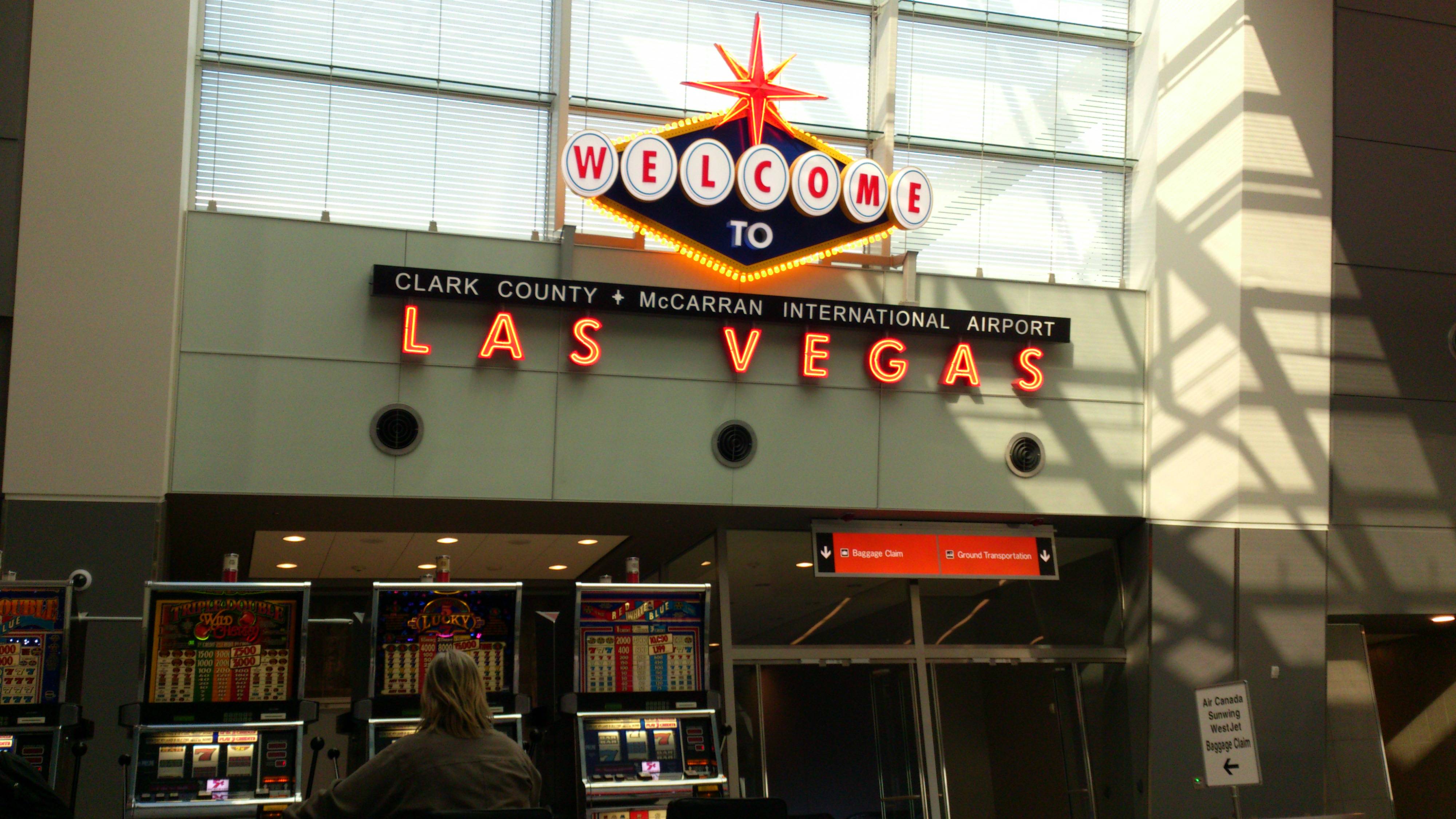
We stayed in the LVH hotel, which is one of the icons of Las Vegas, opened in 1969 and operated by Hilton until late 2011. It is not very new, but still pretty nice. As always we used public transport and we should have learned from previous experiences. Again the bus did not give any change, so we payed $20 instead of $10 (for a 24-hour ticket), but reached the hotel quickly.
When I went shopping I used the buses again, but ended up walking a lot, mainly because I did not have mobile internet anymore and couldn’t really find out which bus was going when and from where. I admit having been a little afraid all the time, there’s really strange people running around, especially after it got dark. I also saw some police who had obviously found drugs in a car and were interrogating the driver on the spot – somehow I get the impression American cops like that.
To avoid wasting time sleeping we went down to the strip at about 11 p.m. This is the really awesome part of Vegas – you can see, feel and taste the money. There’s a huge copy of the Eiffel tower and even of the statue of liberty. Every new hotel & casino tries something else to be unique and impress people.
While it is interesting to have seen this, I am happy to only have had to stay here for one day. It’s really crazy and there’s nothing to do except eating (cheap), enjoying all kinds of entertainment (expensive) and gambling (even more expensive).